Trucking jobs are everywhere or at least, that’s what everyone is saying.
Scroll through social media and you’ll see content over and over again about: “Driver shortages.” “Trucking companies are desperate for drivers.” “Just get your CDL and you’ll be making six figures in no time.”
But here you are, CDL in hand, applying to jobs, but nobody’s calling back.
Well, welcome to the part they don’t tell you about on social media and in trucking schools.
The process of getting your CDL is tough, but getting hired with no experience? That’s where most new drivers get stuck.
The truth is, trucking has plenty of jobs, just not all of them are open to rookies!
And if you don’t know where to look or how to approach this process, you’ll spend weeks or months filling out job applications that lead to nowhere.
Here’s what this post will do.
You’re about to learn the 5 steps that turn a fresh CDL into a real paycheck. From finding companies that actually hire new drivers to talking to recruiters that don’t waste your time.
By the end, you’ll know exactly what you need to do to get hired, where to apply, and how to set up your first year on the road so that you can make it count.
Let’s get to it.
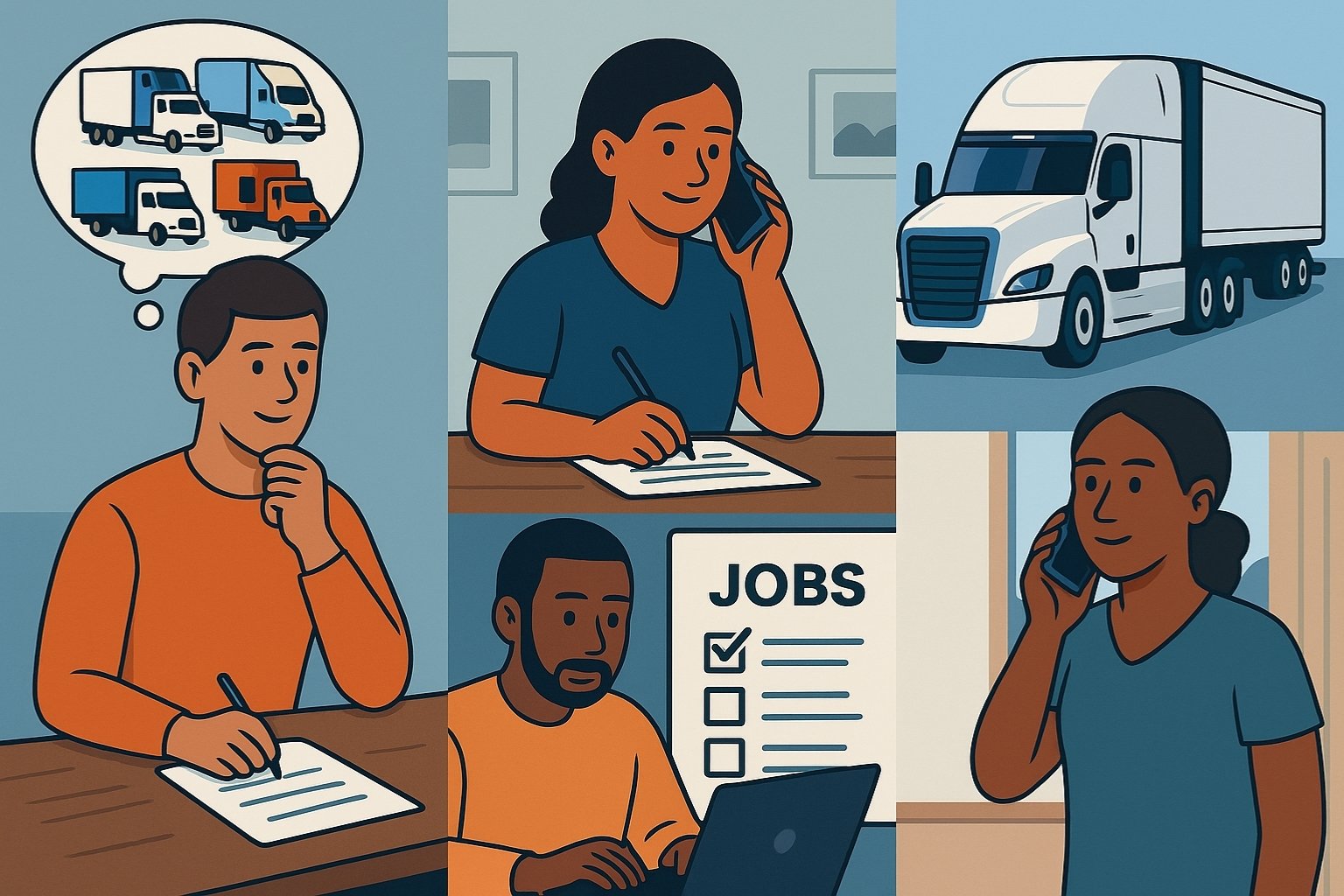
So here’s the million-dollar question: If the trucking industry keeps saying there’s a “driver shortage,” then why is it so hard for new CDL drivers to get hired?
The short answer is the trucking industry isn’t short on drivers, it’s short on experienced ones.
When you’re brand new, you don’t have verified driving miles, no record of safe deliveries, and no reputation in the industry yet.
From the company’s point of view, that means RISK and the commercial insurance companies hate risk.
But let’s flip the script right quick.
Obviously, as a new CDL driver you know how hard it is to get a trucking job but let’s look at it from the eyes of a trucking company.
When a carrier hires a brand-new driver, they’re not just hiring an employee, they’re taking on a risk.
Every truck represents 10’s of thousands of dollars in equipment that can carry anywhere from 100,000 to millions of dollars in freight.
Every driver (new or experienced) is a risk to the company’s reputation, safety record, and insurance rates.
This is why the majority of fleets cannot take the risk of putting an inexperienced CDL driver behind the wheel without at least one year of verifiable driving experience first.
It’s not personal, their insurance just won’t cover the risk.
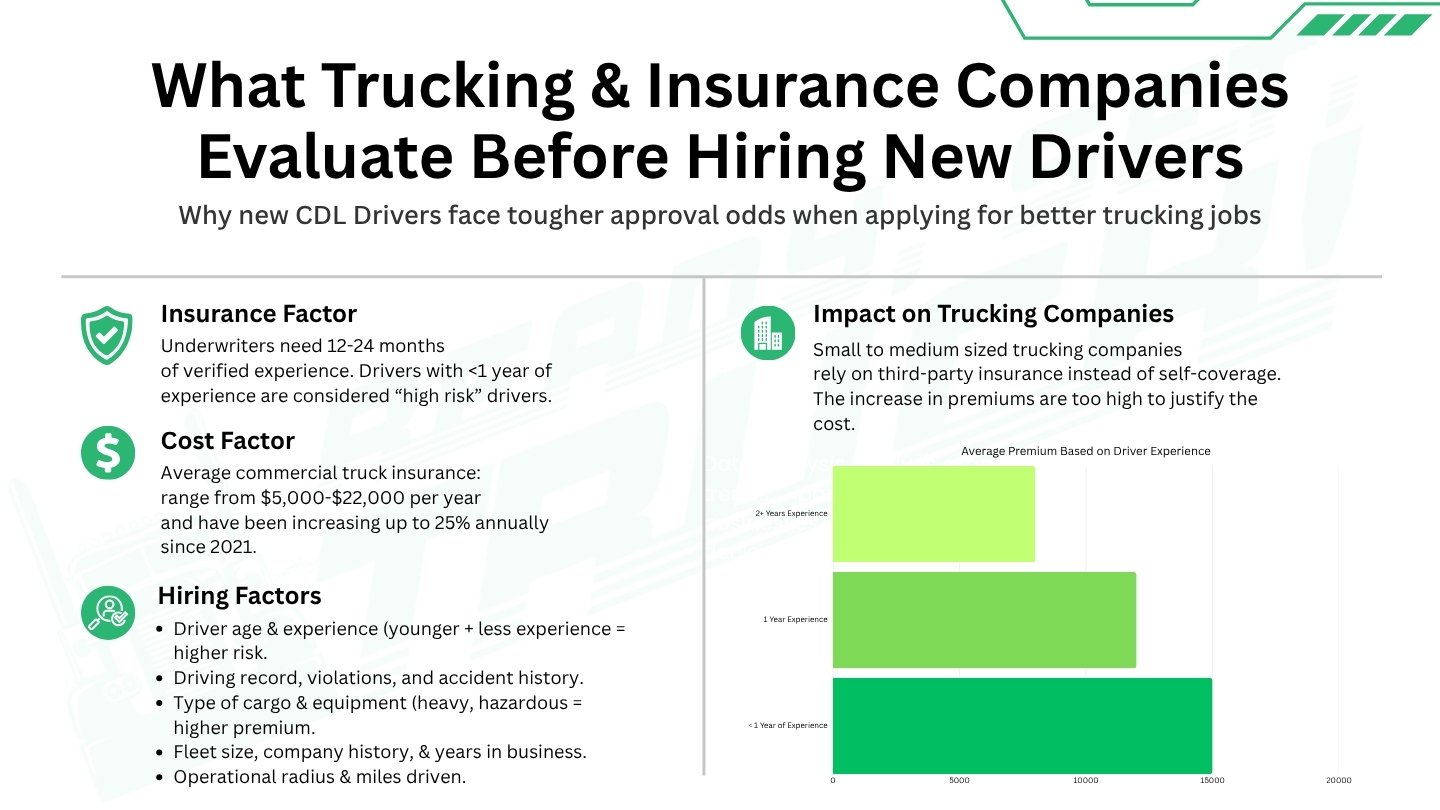
Aggregated data from Insurance Industry averages. Sources = RTS Carrier Services, Schneider Owner Operators, East Insurance Group, GIA Insurance Group.
For most carriers, insurance is the ONLY reason they don’t hire drivers with less than a year of experience.
Commercial trucking insurance companies set very strict requirements for who can and cannot get behind the wheel and those policies are not flexible at all.
Most insurance underwriters require:
So that also means, even if you’ve been driving flatbed for a year, that doesn’t automatically qualify you for a tanker or LTL position.
Each type of freight has a different level of risk. From the insurer’s perspective, rookie drivers haven’t been proven behind the wheel yet.
They don’t have enough history and experience with the seasons and elements to prove they’re safe drivers yet.
One bad accident can cost millions not just in damages, but in lawsuits and insurance rate increases.
That’s why most local or regional companies, especially the ones that offer better pay, benefits, and home time can’t hire drivers with little to no experience.
Their insurance just doesn’t cover it.
Here’s where the big boys come into play. Companies like Prime, Swift, Schneider, and CR England can afford to hire new CDL drivers because they’re self-insured.
That means they make so much money (and have enough trucks on the road) to cover their own insurance risk internally instead of relying solely on third-party insurance.
They have their own in-house safety departments, training programs, and huge insurance funds set aside.
So if a rookie driver makes a mistake, it doesn’t completely jeopardize the company’s insurance rating.
That’s also why they can afford to train you, pay for your expenses during orientation, and keep you out for weeks at a time while you learn. They’re not charities, they’re businesses.
Their business model is based on volume.
But of course, these jobs come with trade-offs:
These carriers are the main gateway for new drivers to get their first year of verifiable experience that opens every other door in trucking.
This is how the majority of drivers get their experience, including myself.
Smaller regional or local carriers don’t have the same cushion. They solely rely on commercial insurance companies to cover their trucks and that means no exceptions.
If their policy says every driver must have one year of experience, they can’t hire someone fresh out of school even if they wanted to.
It’s not that they don’t believe in you. It’s that their insurance literally won’t let them.
And even if they could, they’d be risking a huge premium increase or losing coverage altogether if an accident happens.
That’s why experienced drivers, especially those with time in a specific type of freight always move to the front of the line.
A driver with one year of safe flatbed experience is worth gold to a company running regional flatbeds.
Same for reefer, tanker, or hazmat. They’re not just hiring a driver, they’re buying proof that person knows what they’re doing.
Think about it like this:
Every job posting gets dozens, sometimes hundreds of applications. When a recruiter sees “no experience” next to “one year of regional tanker experience,” it’s not even close.
The experienced driver gets the call 99% of the time.
That doesn’t mean you can’t break through though, it just means you have to approach it strategically, targeting the companies that are actually set up for new drivers.
That’s exactly what we’re going to cover next.
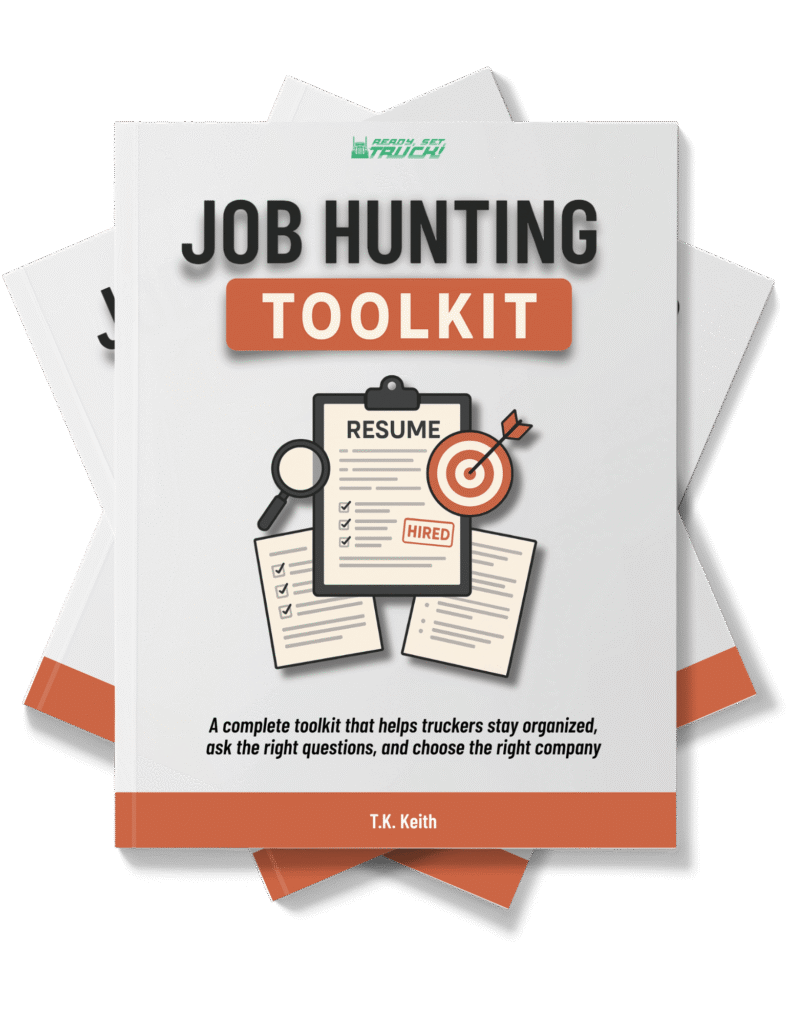
Grab the Job Hunting Toolkit and get the questions, comparison sheets, and shortcuts that help rookies win better offers with no experience.
Your first trucking job isn’t always about getting the perfect trucking job, it’s about gaining experience that opens doors.
The first year of trucking is your foundation.
It’s what insurance companies, recruiters, and other trucking companies will look at before giving you better pay, better lanes, and better home time.
So before you start applying, you need to know which trucking jobs for new CDL drivers actually help you build verifiable experience.
Here are the top 5 options that help you get experience.
If you’re a brand-new driver, starter carriers, also called mega carriers are where most rookies will have to begin.
Companies like Prime, Swift, Schneider, CR England, Knight, and Werner specialize in hiring and training new CDL holders.
They’re large, self-insured fleets with systems, safety programs, and trainers to take rookies straight from CDL school to learning how to do the job properly on the open road.
👍 Pros:
👎 Cons:
These are some smaller and regional carriers like Roehl, TMC, Halvor Lines, Melton, and Nussbaum that hire brand new CDL drivers through completion or mentorships programs.
These aren’t advertised as widely as mega-carrier jobs, but they tend to have better environments for learning.
You’ll get feedback, easier face-to-face communication, and generally more personal support.
👍 Pros:
👎 Cons:
Once you finish training, some carriers move rookies onto dedicated accounts for large retailers like Walmart, Target, Dollar General, or Home Depot.
A training student of mine got picked up for a regional account a few days before finishing his upgrade test.
So don’t count it out, depending on where you live, there might be local or regional routes willing to take on brand new CDL drivers fresh out of training.
These opportunities are pretty rare, so when they pop up, take advantage of them.
👍 Pros:
👎 Cons:
The Job Hunting Toolkit gives you the exact questions to ask, recruiter conversation tracker to stay organized, and the resumes that help you stand out even with zero experience.
Most new CDL drivers start off with dry van freight, but if you’re willing to do a little extra work, specialized freight could get you ahead faster.
These are the jobs that teach skill, precision and they typically offer pay better for a rookie drivers.
Companies like Melton, TMC, and Western Express hire CDL graduates for flatbed trucking, where you’ll learn load securement, tarping, and the precision you need to do the job.
Others like Prime’s Tanker Division, Foodliner, and Schneider Bulk offer tanker jobs for entry-level drivers who meet their safety and training standards.
And if you’re looking for something more consistent, reefer (refrigerated) carriers such as KLLM, Marten, and Knight give you steady freight year-round.
👍 Pros:
👎 Cons:
Not every new driver can afford to go OTR and that’s perfectly fine.
Companies like Sysco, Pepsi, Waste Management, and Old Dominion offer dock-to-driver programs and local routes that accept CDL graduates.
These roles can help you stay close to home while still gaining experience behind the wheel.
👍 Pros:
👎 Cons:
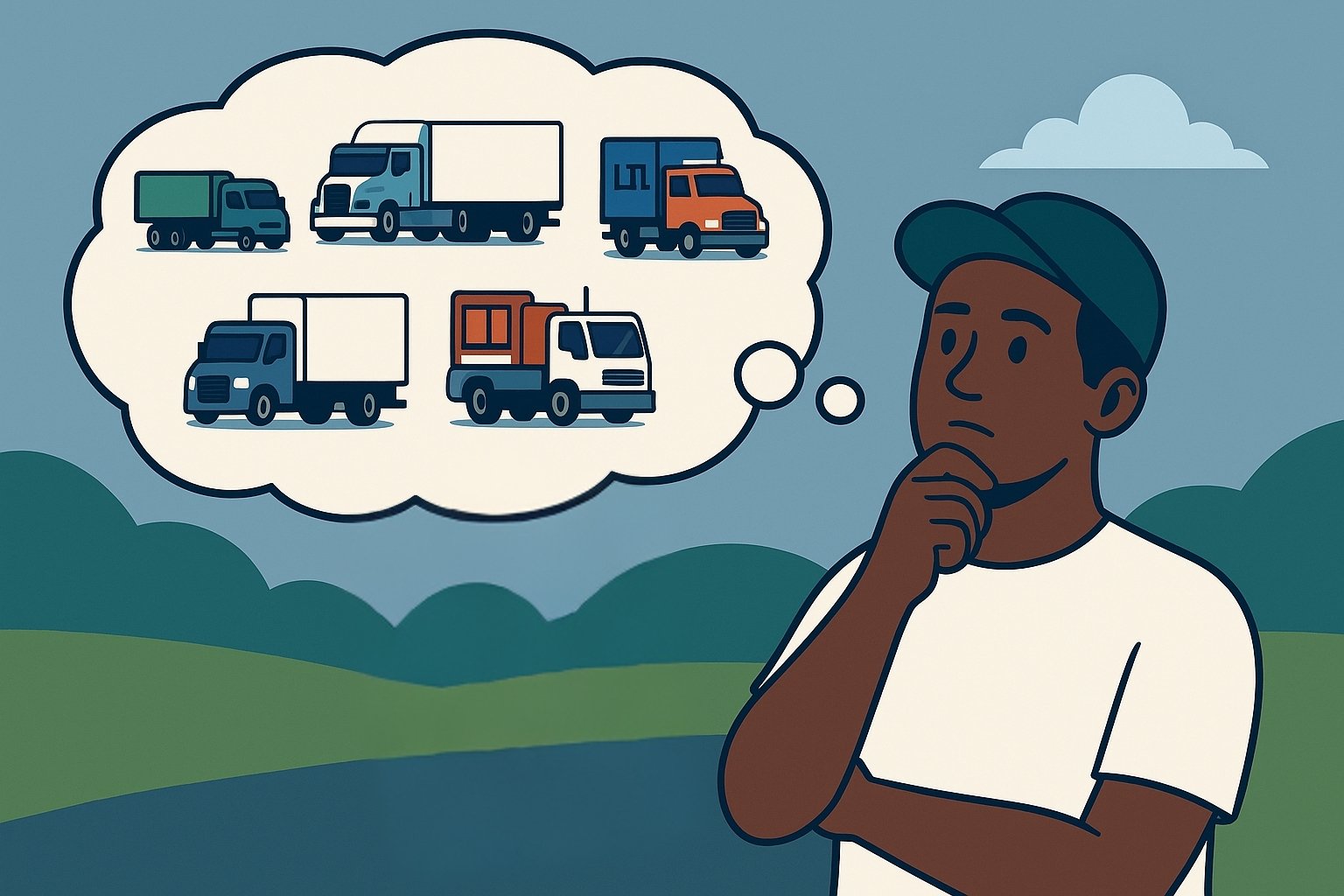
Every CDL driver’s ideal trucking job is one that gives them more money, more time at home and less work.
The problem is most trucking jobs only offer a few of these at a time. You might be able to get the home time but the pay isn’t going to be good.
Or you might get the pay but you’ll be gone from home for weeks at a time.
But there’s some good news, there are ways to get flexibility early on. It takes a little extra effort, networking, and knowing where to look but there are options.
Here are five ways to gain a more flexible trucking experience with a schedule that better fits an ideal trucking lifestyle.
One of the best ways to get a surprisingly good trucking job with no experience is by knowing the right people.
Stay in touch with your CDL school instructors, talk to drivers at truck stops, and go into Facebook or Reddit groups where local carriers post openings.
Some smaller fleets and regional companies don’t always advertise online but prefer hiring new drivers through referrals.
👍 Pros:
👎 Cons:
If you’re not able to get hired right away, don’t sleep on yard jockey or spotter jobs.
You’ll move trailers around terminals, ports, or warehouses all while building up your backing skills in a real truck.
New drivers don’t understand how valuable the skill of backing in trucking is until they’re out there and can’t get into tight spots.
Trucking companies and warehouses have yard drivers to road positions after a few months when new opportunities open up.
👍 Pros:
👎 Cons:
When trucking companies say “come back after six months,” try seasonal work.
Short-term freight jobs like, harvest runs, postal contracts, holiday freight still counts as verifiable experience.
Temp agencies that specialize in CDL drivers like Trillium, Centerline, or ProDrivers place entry-level truck drivers on short-term contracts that can turn into full-time work.
Don’t underestimate short-term work. Three months of safe driving on a seasonal contract can open doors that a brand new CDL alone won’t.
👍 Pros:
👎 Cons:
Big brands like Walmart, Publix, PepsiCo, and Sysco run their own private fleets and some have development programs for new CDL drivers.
LTL (Less-Than-Truckload) carriers like Old Dominion, Estes, and Saia also hire dockworkers with CDLs or apprentices who move into short linehaul routes.
These jobs are great for rookies who want stable freight and predictable home time.
👍 Pros:
👎 Cons:
👍 Pros:
👎 Cons:
You don’t have to wait years to build a trucking career that fits your life.
Flexibility comes from creativity, finding overlooked routes, showing up where others don’t, and proving yourself one mile at a time.
Next, we’ll turn everything you’ve learned into a step-by-step plan that takes you from new CDL driver to your first official driving job gaining experience.
Every company says they’re hire new drivers, but once you start applying, you’ll find out it’s not as easy as they make it seem.
Recruiters take forever to get back in touch with you. Job boards send you in circles. And you’re sitting there thinking, “They said they were hiring CDL drivers in my area, why is this so hard?”
Getting your first trucking job isn’t about luck, it’s about understanding the process. Drivers that get hired fast don’t just apply and wait, they work the system.
These 5 steps walk you through the exact process; what to do, who to call, what to ask, and how to follow up.
This way you can land your first paid driving job and start building real experience.
Before you send a single application, decide what kind of job fits your life, not just your paycheck.
Write down 3-5 job types you’d be willing to take. That way, if your first choice isn’t hiring new grads, you’ve got backup plans ready to go.
Example:
Don’t just apply everywhere and hope for the best. Most “CDL jobs” you see online have been filled already, basic lead generation software, or flat-out scams.
You’ll save yourself time (and a lot of frustration) by focusing on the companies that actually hire new CDL drivers, not the “minimum 1 year experience” listings.
Here’s how to go about it the right way:
Skip the middlemen and go straight to carrier career pages. Search for divisions or programs that say “recent graduates,” “entry-level,” or “finishing program.”
Some good places to start: Schneider, Swift, CR England, Werner and Prime.
Bookmark each one and double check things like training length, pay during training, and home time.
Sites like Indeed, CDLjobs.com, ZipRecruiter, and JobsInTrucks can still work, but you have to filter and dig through the listings.
Search for:
“CDL A recent graduate” or “entry level new CDL drivers.”
Avoid listings that:
If it looks too good to be true, it’s probably a recruiting funnel, not a real carrier.
Use Google Maps to search “trucking companies near me” or “CDL A carriers in [your city/state].
Click through to each company’s website and look for a “Careers” or “Jobs” page.
Again, even small fleets hire rookies when they’re short on dependable drivers, they just don’t advertise it online.
If they don’t show an opening, call anyway. You’ll be surprised when they say, “Actually, we are hiring right now.
Don’t be afraid to look into flatbed, reefer, intermodal, or tanker jobs to see if you qualify.
Companies like Melton, TMC, KLLM, and Foodliner all hire CDL grads and will teach you specialized skills that pay more starting out.
These fleets typically offer regional freight positions that gives even drivers more home time and flexibility.
Once you start calling and applying, things move fast. Recruiters reach out, send follow-up texts, and call from different numbers.
If you’re not keeping notes, it’s easy to forget who said what or which one best fits your goal.
Here’s an example of a simple tracker that you can create:
Company
Schneider
Recruiter Name
Sarah P.
Phone Number
808-777-9311
Date
10/5/2025
Notes
Paid training, home biweekly
Next Step
Follow up next Wednesday.
If you’d rather skip building one yourself, you can download our Job Hunting Toolkit.
It includes questions for recruiter calls, a conversation tracking sheet, and resume templates so you can stay focused on getting hired instead of keeping up with paperwork.
Use the recruiter printable conversation tracker worksheet inside of Job Hunting Toolkit to track recruiter calls, and avoid getting stuck at a dead-end job that slows you down.
Before you hit “apply,” talk to someone first. Recruiters get hundreds of online applications every week, but most of them get filtered out or overlooked.
When you call or email before applying, your name can jump to the top because you’ve already made human contact.
Having your CDL opens the door, but your conversation gets you inside.
Go to the company’s website, look for the Driver Recruiting or Contact page.
If you can’t find their direct phone number, check LinkedIn or Facebook, most carriers list their recruiting department’s information on their social media pages.
Others might use an external hiring process through something like tenstreet.com.
Here are a few questions that matter most for new CDL drivers.
If you can’t get a clear answer from them, move on to the next company.
Don’t waste your time, there are plenty of other options out there.
Hiring Policy
Training
Pay
Home Time
Contract
Start Date
“Do you hire recent CDL graduates or require experience?”
“How long is the trainer phase before going solo?”
“What’s the pay during training, and what does it go up to after I upgrade?”
“How often can I expect to get home during my first year?”
“Is there a contract or repayment policy for training?”
“How soon can I start orientation if approved?”
Hiring Policy
Training
Pay
Home Time
Contract
Start Date
“Do you hire recent CDL graduates or require experience?”
“How long is the trainer phase before going solo?”
“What’s the pay during training, and what does it go up to after I upgrade?”
“How often can I expect to get home during my first year?”
“Is there a contract or repayment policy for training?”
“How soon can I start orientation if approved?”
Don’t just put all of your hopes and dreams on one company. Even if you like what you hear from the recruiter, it’s smart to apply to 3-5 carriers at the same time.
This gives you options, leverage, and a backup plan if one doesn’t come through.
But don’t just throw out applications everywhere, here’s a better way you can do it:
Carriers that accept document uploads process applications faster.
When a recruiter sees a completed app plus your CDL certificate, MVR, and medical card, you look ready to rock and roll, not just curious.
If the site doesn’t have an upload option, finish the short form and then attach or email your resume right after (see next step).
Don’t wait for them to call you, take the initiative.
Once you hit submit, give it a couple of hours and then call or email the recruiter saying something like this:
“Hey [Recruiter Name], this is [Your Name]. I just wanted to follow up and let you know that I applied for the entry-level CDL position and wanted to make sure you saw it.”
Then you would just ask a few questions about their hiring process and what you can expect to happen next. You never know, that short follow up could be the very thing that bumps your name to the top of the list.
This is where you need to be prepared. Because once they go through your application, they’ll be reaching out to have you send over some basic records . This is a very good sign!
Keep digital copies of everything in one folder so you can send them instantly when the ask:
Recruiters can move on fast if you can’t respond quickly. Having your paperwork ready shows you’re serious and saves time in the process.
I have to stress this, every time you apply or speak to a recruiter, record who you talked to, what they said, and when you need to follow up next.
That’s how you stay organized and show them how serious you are.
If you want an easy way to keep your job hunting process organized, grab our CDL Job Hunting Toolkit.
It includes a ready-to-use tracker and recruiter questions to ask so that you stay organized and follow up like a pro.
Use the Job Hunting Toolkit to ask better questions, stay organized, and show companies you’re serious even with zero experience.
You’ve already done the hard part!
You applied, called the recruiter, and asked about the process. Now it’s time to let things breathe a little bit.
Give it a couple of days before reaching back out.
Recruiters have dozens of applications they’re working on at once, and sometimes they’re just waiting on background checks, MVR results, or available dates before calling you back.
While that’s going on, focus on the other applications you already sent out.
Keep your phone close, check your email, and be ready to respond quickly when one of them contacts you.
After 2-3 days, follow up with the recruiter or company representative that you spoke with. Keep it short and focused:
“Hey [Recruiter Name], this is [Your Name]. Just wanted to check in to see if there’s been any updates on my application.”
This little check-in makes a big difference and reminds them you’re serious, reliable, and actively looking.
You’ll usually know you’re about to get hired long before anyone says the words, “You’re hired.” It starts with a shift in the recruiter’s tone.
They’ll ask for your CDL school start and completion dates, go over your employment history, and have you sign background check waivers and pre-authorization forms as part of your application.
They might ask for copies of your CDL and medical card, and sometimes you’ll even get a conditional job offer or pre-hire letter sent by email.
That’s not a guarantee you’re hired yet, but it means you’ve made it past the first part of the process.
From here, you’re officially in their system, and they’re just waiting for your final screenings to clear.
Once the pre-hiring phase starts, it might go quiet for a few days, that’s normal. The company is still running checks behind the scenes.
Here’s why:
This part takes time. Recruiters can’t rush it, so use this time to make sure you’re ready to roll.
Some trucking companies might email you a conditional job offer or pre-hire letter that’s your sign they’re ready to move forward, pending your verification.
Once they start checking your history and sending paperwork, you’re not just a lead anymore, you’re in their hiring phase.
When everything clears, you’ll get your orientation call or email.
That’s where the next phase begins. The recruiter or orientation coordinator will give you the report date, location, and travel details (it’s usually a bus ticket and hotel information).
Be sure to ask about:
Keep your CDL, med card, Social Security card, and any paperwork they request in a safe place. I recommend keeping your documents in a large envelope or folder.
It makes it easier, especially in those early mornings when you need to rush down to the shuttle that takes you to orientation.
Even though you already have a valid medical card, expect them to redo your DOT physical and another drug test during orientation (most trucking companies do this as part of their standard process).
Pro Tip:
Recruiters say a lot of things to a lot of people! Make sure to have everything in writing before you leave for orientation. I’ve had recruiters tell me one thing only to get to orientation and be told something completely different. So please, get EVERYTHING in writing!
By now, you know that getting a trucking job with no experience isn’t always easy, but there are plenty of options available.
Most new CDL drivers believe they just have to wait it out, but hopefully this post has shown you that there are a lot of opportunities with a CDL.
It’s not about luck, timing, or knowing everything about trucking. Getting a trucking job without experience is about being proactive, organized, and open to other avenues.
We’ve covered trucking company’s limitations, what they look for, how to talk to recruiters, and what to expect once you’ve finally been hired.
Now it’s on you to stay persistent and keep applying, following up, and treating every call like it could change your future.
Because it can.
Once that first company gives you a chance, everything changes. You’ll go from trying to get hired to learning how to succeed behind the wheel. That’s what your first year is all about… progress.
If you’re ready to learn how to shorten your learning curve, join the Trucking Success Newsletter.
It walks you through managing your money, trip planning, and building a reputation that opens more doors in trucking.
The Job Hunting Toolkit gives you the right questions, clean resume templates, and a recruiter tracker so you always know your next move.
Free PDF Download
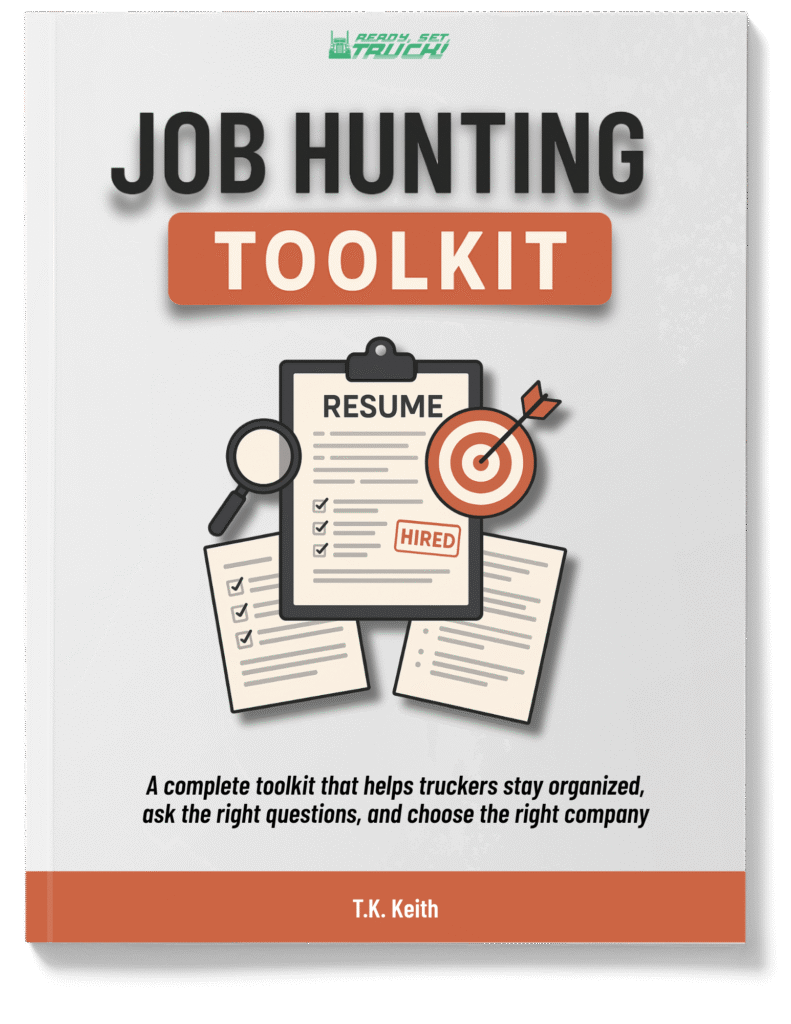
The Job Hunting Toolkit makes comparing offers, asking the right questions, and picking the best job easier. With 30+ questions for recruiters, resume templates, and a recruiter conversation tracker, to help you decide which company is worth your time and which ones to walk away from.
Enter your details below to access your free Job Hunting Toolkit
We process your personal data as stated in our Privacy Policy. You may withdraw your consent at any time by clicking the unsubscribe link at the bottom of any of our emails.

T.K. Keith – “The Truckers Trainer”
After spending 20+ years as a trucker and over six years training new drivers. I know first hand the ups, downs, and lessons that come with the first year behind the wheel. Ready, Set, Truck! is my way of helping new drivers build confidence, make more money, and find success in trucking.
Readysettruck.com
No elements found...
No posts found...
Ready, Set, Truck! helps drivers succeed in their first year on the road with tools, tips, and resources to avoid going broke, burning out, or giving up.
TOOLS
Copyright © 2025 Ready, Set, Truck! LLC. • All Rights Reserved • Privacy Policy • Legal Policies